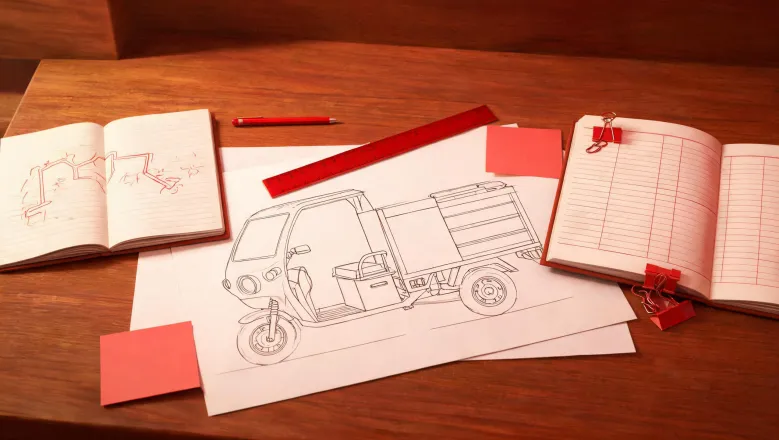
The most useful hygiene yardstick for the Mingnuo MN-H30X electric sanitation tricycle is not a vehicle badge. It is a trash-can rule. 29 CFR 1910.141, written for permanent workplaces rather than vehicles, requires any receptacle holding putrescible solid or liquid waste to be built so it does not leak and can be thoroughly cleaned, and to carry a solid tight-fitting cover unless it can be kept sanitary without one. That reframes the buyer's question. Instead of asking whether the box is labeled sanitation-compliant, you ask whether this box can contain waste, be cleaned, and be emptied without leaving residue behind.
Everything below is bounded to one named case: the Mingnuo MN-H30X OEM export page. No US road approval is established for it, and the page disagrees with itself on two points that matter here. The body appears as a two-bin configuration in one description and as a single 500L box in another, and the resin is called high-density polyethylene and PP in the same sentence. The judgment that follows hangs on three physical conditions: how the cover seats, how cleanable the interior is, and what the dump path leaves behind. The label ranks fourth.
Judge the Box as a Waste Receptacle First
Strip away the marketing and a waste box has one physical job: hold solids and liquids inside a moving vehicle, let a person clean it thoroughly, and release its contents without turning that release into a health hazard. 29 CFR 1910.141 gives you three criteria you can inspect against. The first is construction, meaning no leaks and thorough cleaning possible. The second is a solid cover that closes tightly, unless the box can be maintained sanitary without one. The third is removal carried out so as to avoid creating a menace to health, and done as often as needed to keep the place sanitary.
Each criterion names a failure you can see on a unit rather than a certificate you have to trust. A leak shows up as a stain trail down the shell. A cover that does not seat shows up as a lifted lip at one corner. A dump path that holds material shows up as a scrape mark on the hinge side wall. Enclosure alone does not get you there, because a sealed box that cannot be cleaned or emptied cleanly still fails the second and third criteria. The whole question comes down to three checks you can run with your hands and a flashlight.
Keep the scope limit in view. This is a workplace housekeeping rule for permanent places of employment, quoted for what it says about containers; it certifies no vehicle and approves nothing for road use. What it does is hand you a checklist that survives contact with a real tricycle instead of dissolving at the first brochure.
Make the Cover Prove It Seats
The hygiene claim on the MN-H30X rests on a fully enclosed structure with a cover-within-a-cover design to stop garbage leaking or flying during operation. That design has a logic worth understanding before you test it. The inner cover is the barrier that has to seat against the box opening; the outer cover shields the seating area from weather, debris and impact. Which means the part that actually keeps liquid in is the inner cover's contact with the rim, and a photograph of a closed box shows you none of that contact.
At handover, work the cover. Open and close it several times and watch the full perimeter of the inner cover meet the rim instead of rocking on two corners. Tilt the empty box and see whether the latch by itself holds the cover down. Ask whether the inner cover uses a gasket or an interference fit, and what keeps it from lifting when the box is loaded and the frame flexes over a curb. These are inspection questions with visible answers, not a certified test, and nobody should describe them as one.
That regulatory cover criterion is the standard your eye is borrowing here. A cover that seats on three sides and lifts on the fourth fails the idea even on a day when nothing escapes, because seating is a property of the whole perimeter, not of the moment you happened to look.
Read Cleanability From the Interior
The page gives one clean figure for the box: the 500L box is made from 100% high-density polyethylene, molded in a single injection, with resistance to acids, alkalis and corrosion. The single-injection part is what matters for hygiene. Seams, bolted brackets and overlapping panels are where residue collects and where a rag cannot reach, which means cleanability is strongest exactly where the interior carries no added seams, no ledges above the floor line, and no exposed hardware.
Ask for photographs of the empty interior before you commit: the floor-to-wall radius, the drain or cleanout point, the place where the tilt hinge passes through the shell. A generous radius rinses out with a hose. A square corner with a bead of sealant does not, and that corner decides how long a wash-down takes on a hot afternoon.
Read that material sentence twice and the number loses some of its shine. Polyethylene and PP are different polymer families with different stiffness and chemical resistance, and the page uses both names for the same box. Request the resin datasheet or molding specification, and the exact capacity of the box you are buying. Thorough cleaning and no leaks is the criterion; the datasheet is what tells you whether this shell can meet it.
Follow the Waste Out of the Box
Dumping is where a box either finishes the job or hands it back to the operator. The page states that the dustbin tilts for complete and quick dumping and that the rear of the box carries casters to protect it from damage. Those casters are a small detail with a real consequence: if the rear edge rides on pavement while the box tilts, the shell takes abrasion at the same corner where waste is most likely to hang up.
Waste clings where geometry changes, which is why the dump path deserves its own check. Wet paper, leaves and food waste stay on the hinge-side wall and behind the lip, so a box that sheds most of its load can still cost someone a manual scrape every cycle. That turns a claimed complete dump into a daily labor line, and it is the kind of failure that surfaces in complaints months after delivery rather than during the demo.
After you watch a tilt, look inside the emptied box rather than at the pile on the ground. Where does material sit? Can the operator reach it without climbing into the box? Do the casters hold the rear edge clear of the surface? The 29 CFR removal criterion asks that waste be removed so as to avoid creating a menace to health, and that standard is met by the routine, not by the first dump. The page publishes no dump angle, cycle time or residue result, so treat any figure you hear verbally as unconfirmed until it appears in the specification you sign.
Reconcile the Supplier's Labels Before You Accept
Here is where the paperwork decides the verdict. The page's only hard number is the material percentage, and the sentence carrying it names the polymer two ways. The body labels disagree as well. This cannot be waved off as a translation slip, because capacity and resin are the two inputs that decide how you clean the box and what you inspect. Bin geometry and box volume set the interior shape, the wash-down routine, and probably the cover hardware.
So put five items in writing before you accept any hygiene statement: the exact model and version being quoted, the box capacity in liters for that version, the resin datasheet or molding specification, the cover and latch part numbers, and a statement that the page is an OEM export description with no established US road approval. Add one question about which of the conflicting body labels applies to the unit you will actually receive.
If the supplier reconciles them, you have a configuration you can inspect against the criteria above. If it cannot, the hygiene claim stays unverified, which is not the same as disproven; it simply means the claim is unsupported at the level where money changes hands. Two of those five items cost the supplier nothing but an email, and how those two come back tells you about the other three.
The Tradeoff Between Verifiable and Convenient
I would take the inspectable configuration over the reassuring phrase every time. Choose it and you gain a box whose hygiene you can check at handover and re-check at every service interval, because cover seating, interior surface and dump-path residue are all visible conditions a buyer or a technician can look at and photograph. You give up the convenience of accepting sanitation-compliant at face value, and you take on a documentation burden: a quote that names the version, the capacity and the resin, plus someone on your side who will open the cover and tilt the empty box before the invoice clears.
The ongoing part is the honest cost: a cover gasket compresses, a latch wears, and a hinge area keeps what the box did not release. Nothing on the page establishes a service interval for any of them, which means the check schedule is yours to set rather than the supplier's to hand you.
That is the trade: more verification work in exchange for a hygiene claim you can defend in front of a depot manager, with the unresolved body labels and the polyethylene against PP wording standing between you and that claim until someone puts the answer in writing.

Discuss this electric sanitation tricycle requirement
Use the sourcing form for a configuration-specific question. Include quantity and destination so open ratings, evidence and delivery assumptions can be reviewed in context.