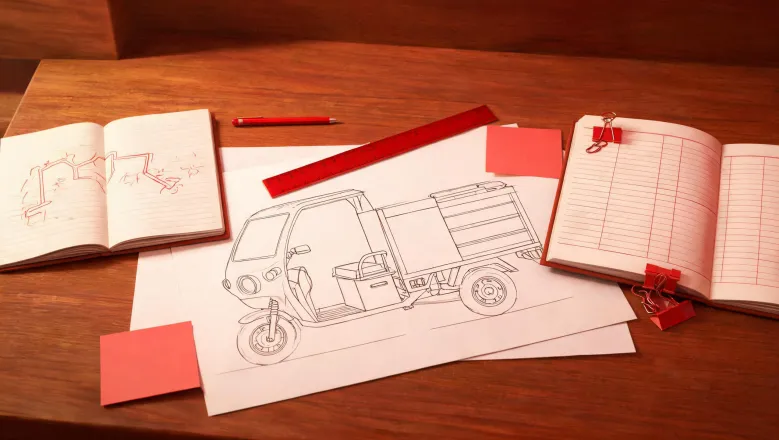
Evaluate payload and container capacity by anchoring on the rated load for the exact model in front of you, measured in kilograms, then checking whether the container volume can actually be filled with your waste stream before that weight limit is reached. One condition reshapes the exercise: on the Mingnuo MN-H30X export page, the only model this article covers, the body is listed both as a pair of 240 L bins and as a 500 L box, so the capacity figure you evaluate has to be pinned to the configuration that will actually ship.
Both numbers sit in the same spec block — Trash Can 500 L, machine weight 160 kg, rated load 200 kg — and buyers routinely read the first one and skip the third. That habit is the expensive one.
Why the Rated Load Comes First
Two hundred kilograms spread across 500 litres works out to about 0.4 kg per litre. That single conversion tells you what kind of waste the box was dimensioned for, because a container at roughly 0.4 kg/L is sized for a light, bulky stream — litter, packaging, dry sweepings, leaves — and stops being generous the moment the load gets dense.
Wet food waste, sand, broken glass and soaked cardboard typically pass 0.4 kg/L long before the box looks full. Which means the kilogram rating, not the litre figure, is the limit that binds on those routes, and a spec sheet that leads with litres leads with the number that decides the least.
Suppose your crew's wet canteen waste runs heavier than that threshold. Three 120 L bins at 0.7 kg/L would come to 252 kg, past the 200 kg rating while the 500 L box is still well short of full — the machine is over its rating before it looks overloaded.
Match the Box to What You Haul
The MN-H30X is built around one operator doing stop-and-go collection: urban street cleaning, factory floors, schools, hospitals, residential blocks, government sites, patrol routes. Litres only convert into usable capacity when the stream is low-density, and the reason is plain geometry — bulky litter fills a box by volume, while wet or abrasive loads fill it by weight first.
The same 500 L box therefore delivers different effective capacity on a leaf-and-packaging route than on a wet-canteen route. No supplier page can resolve that for you, because the deciding variable is your waste, not their container.
Construction enters the capacity question more slowly. The box is fully enclosed, with a cover-within-a-cover design aimed at stopping waste from leaking or flying during operation, and the 500 L version is described as 100% high-density polyethylene, single-injection moulded, resistant to acids, alkalis and corrosion. A box that resists what it carries is more likely to keep its nominal litres; one that softens or cracks quietly loses them, and you find out mid-route.
Check the Payload Rating Against Your Route
The 200 kg figure is a system limit, not a property of the box. It spans frame, springs, container and dump mechanism: the front suspension is an enlarged dual-cylinder coil-spring fork, the rear is non-independent, and the supplier credits that layout with load-bearing capacity. A non-independent rear axle shares load between the two rear wheels, which means 200 kg carried high and off-centre is not the same duty as 200 kg carried low and level.
That distinction shows up on curbs, ramps and broken pavement, where a tall box lifts the centre of gravity and the load leans. Nothing on the page quantifies slope, surface or route conditions, so treat 200 kg as the ceiling for this named model and put your route questions to the supplier in writing rather than assuming a margin that was never published.
The emptying path belongs in the same check. The dustbin tilts for complete, quick dumping, and the rear of the box carries casters to protect it from damage during the tip — both details that decide how the container behaves at the one moment each cycle when the load is moving.
A Five-Step Spec Review You Can Run
Work through the sheet in this order and payload and capacity both end up settled instead of half-answered.
Pin the exact model and version first. This model is listed with two different bodies, and they are not the same container even under one model number, so capacity means nothing until the configuration is named.
Next, copy the rated load in kilograms onto your comparison sheet and leave the litres off it for now. Put it bluntly: the litre figure is the one that sells the machine, the kilogram figure is the one that limits it.
Then weigh a full container of your own typical waste and hold your own kg/L against the ratio implied by the 500 L box and 200 kg rating. Nobody needs a lab for this — a bathroom scale and one loaded bin will do — and your number beats anything printed on a spec sheet, because it is the only one measured on your route.
From there, read the box construction, here the single-injection moulded polyethylene described on the page, acid-, alkali- and corrosion-resistant, since a container that degrades resets the real capacity rather than the nominal one. Finish on the emptying path: tiltable dustbin, rear casters, and how many seconds a tip actually costs.
Confirm the Exact Configuration Before Ordering
Ask for the exact-version sheet and the unit nameplate showing rated load in kilograms and which body ships. One page carrying two different bodies is a documentation problem you want resolved before the invoice, not after the unit lands.
Ask in writing which polymer the box is. The page states 100% high-density polyethylene and then puts PP in parentheses, and those are not the same material, so the answer belongs on paper. Ask as well whether the model they will ship is offered in a configuration legal for US road use; the page establishes no US approval, and everything here stays inside the named export-model scope rather than implying one.
You know you did it right when the kilograms and the container configuration you evaluated reappear, in the same units, on the document that travels with the machine.
Where a Bigger Box Costs You
At rated load the vehicle is carrying 360 kg gross — 160 kg of machine plus 200 kg of waste — on the same drivetrain, the same springs and one operator. A larger box adds structure and tare that combination has to move all shift, whether or not the extra volume gets used.
It comes down to the density of your stream whether a big box earns its volume or rides around half empty. On a light stream it buys fewer trips to the dump point. On a dense stream it buys nothing but tare, and the container reaches 200 kg while still well short of full — the worst version of the trade, because the operator stops collecting early and still hauls the volume.
The honest comparison across quotes is trips per shift, not litres on a spec sheet.
Today's move is one email and one weighing. Ask the supplier for the exact-version sheet and nameplate that state the rated load in kg and which body ships, and this afternoon put one full container of your crew's own typical waste on a scale, so you have a kg/L figure of your own to hold against the ratio you worked out from the box volume and rated load. If they cannot state both numbers for the same version, that is the answer: do not take that quote further.

Discuss this electric sanitation tricycle requirement
Use the sourcing form for a configuration-specific question. Include quantity and destination so open ratings, evidence and delivery assumptions can be reviewed in context.