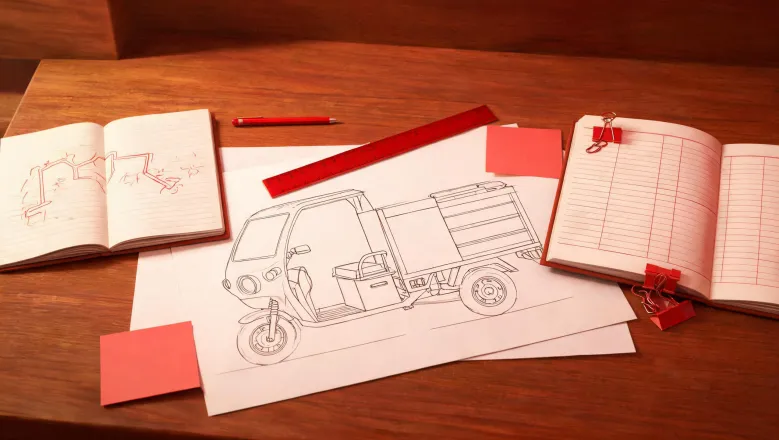
Most buyers read the brake line on an export spec page and walk away with one picture in their head: a single circuit that squeezes everything at once. On a machine like the Mingnuo MN-H30X sanitation electric tricycle, that reading costs you the two parts you most need to check, because the front brake and the parking brake both vanish into the words drum brakes.
The page names three separate mechanical paths: foot-operated mechanical link drum brakes on the rear wheels, a left-hand handle soft-shaft front wheel brake, and a manual mechanical parking brake. Brake lights sit in the safety list, alongside LED lights, turn signals, gauges, an electric horn, rearview mirrors and an anti-theft alarm. Everything below is a reading of that single model page. It is not a rule for the category, and the captured pages do not establish US road-use approval for any of them.
What the MN-H30X Brake Spec Lists
The rear wheels get the drum pair, driven by a pedal through a mechanical linkage, so one input reaches both rear hubs. The front wheel gets a left-hand lever working through a soft shaft, a flexible pull rather than a rigid rod, which lets the control follow a fork that turns with the steering. The parking brake is listed as its own manual mechanical device, sitting apart from both service paths.
That is all the page commits to. It states no stopping distance, no test result and no hydraulic circuit anywhere. What you have is a parts list on a named model, which is the level at which a brake spec is both useful and easy to oversell.
Why the Spec Is More Than Drums
A tricycle is not a car with one wheel removed. One wheel steers, two carry the load, and they do different jobs at different moments. Because one control path cannot act on the steering end and the loaded end with the same timing and the same force, the layout splits them: the rear pair on a foot linkage, the front on the left hand, the stationary hold on a third device. Which means drum brake on its own tells you almost nothing. You need to know which wheels, which control, which moment.
Those three functions are what a buyer is really pricing. A quote that leaves any of them unclear is not a cheaper brake system; it is a quote with a hole in it, and the hole shows up after delivery, not before.
How Another Export Spec Differs
The captured Qiangsheng waste collection tricycle listing fills its entire brake field with four words: double rear drum brake. No front brake named. No parking brake named. That is a different bill of parts from the MN-H30X, and the gap is not cosmetic, because it is the gap between a vehicle with a front-wheel service input and one that appears to lean on the rear pair alone.
Neither page gives you the data to rank them. What they show is that two listings in the same product category describe their brakes at completely different depths, so any assumption that sanitation tricycles share a standard brake set fails the moment you put two sheets side by side.
Why Rear Brakes Carry the Load
Rear brakes are the ones that matter in daily work. Because the collection body and its load sit over the rear axle, and because the page describes a fully welded integrated beam with a split-type differential rear axle and a non-independent rear suspension for load-bearing, the rear wheels hold most of the mass the brakes have to slow, which is why the foot linkage pulls both rear drums together rather than one. Rear first, then the rest.
A pedal beats a second lever here. Because a linkage lets one motion pull both rear drums at once and leaves both hands on the bar, one for steering and one for the front lever the page specifies, the rear pair can work without borrowing a hand. Two hands, two jobs.
Which means a spec that names a front brake but stays silent on the rear is describing the smaller half of the job on this layout. No stopping distance or fade behaviour is claimed here; the page publishes none, and this reading does not invent them.
Why the Front Brake Uses a Soft Shaft
The front wheel steers, so its brake has to reach a part of the vehicle that turns. Because the fork swings with the steering, a control mounted on the handlebar needs a flexible connection to follow it, and that is what the soft shaft does: it carries the pull from the left-hand lever down to the front brake as the fork rotates. Left-hand placement leaves the right side free for throttle and steering input.
The detail worth pressing is independence. A page can say front brake and still mean a system tied into the rear linkage, where one input drags both ends. On this model the front brake has its own lever and its own shaft, so it is a separate input. Ask a supplier directly whether the front control is independent or combined, because the wording alone will not tell you.
Why Parking Brake Is a Separate Device
A parking brake does not modulate motion. It holds a stopped vehicle stopped. Because that job needs a mechanical hold that stays engaged with nobody touching a service control, it cannot be the same device as a pedal you have to keep pressed. The page lists it as its own line for that reason, and counting it as a third service brake overstates the service braking.
Which means a complete brake spec for a vehicle like this should name the parking device separately. If a listing carries no parking line, you do not know whether one is fitted, whether it is mechanical, or whether the rear drums are expected to hold on a grade. That is a question to put to the supplier, not an assumption to carry into a purchase order.
A Loaded-Route Scenario, Clearly Assumed
Suppose a crew works a route where the bin is loaded at every stop and the vehicle parks repeatedly on a slight grade. None of this is a test result; it is a way to frame questions. In that pattern the foot linkage does the stop-to-stop work on the rear drums, the left hand adds front braking when the rider wants it, and the parking device holds the vehicle between stops.
Now imagine the same vehicle quoted with a brake line reading only drum brakes. The scenario predicts nothing about behaviour. It only shows why a one-line brake spec is worth unpacking before a purchase order goes out.
What to Ask a Supplier Before Ordering
Put the questions in writing against the quoted model, not against a website photo. Ask the supplier to confirm that the rear foot-operated mechanical link drum brakes, the left-hand soft-shaft front brake and the manual mechanical parking brake are all installed on the version being quoted. Ask which control triggers the brake light, and get the brake-light circuit into the same answer.
Ask for written confirmation of US road-use applicability, because none of the captured export pages establish it, and a municipal or state fleet cannot treat a supplier page as approval. Ask the supplier to reconcile the page's own conflicting labels as well, since body-capacity figures and a polymer label are both given in more than one form, and a supplier who cannot pin down a body spec is unlikely to pin down a brake spec.
Then go back to the line you first read. Drum brakes was never the answer; it was the label that hid it. The three paths are what the MN-H30X page actually commits to, and a supplier who confirms all three on the quoted model, plus the brake light and the road-use position, has given you a specification. One who will not has given you a web page.

Discuss this electric sanitation tricycle requirement
Use the sourcing form for a configuration-specific question. Include quantity and destination so open ratings, evidence and delivery assumptions can be reviewed in context.